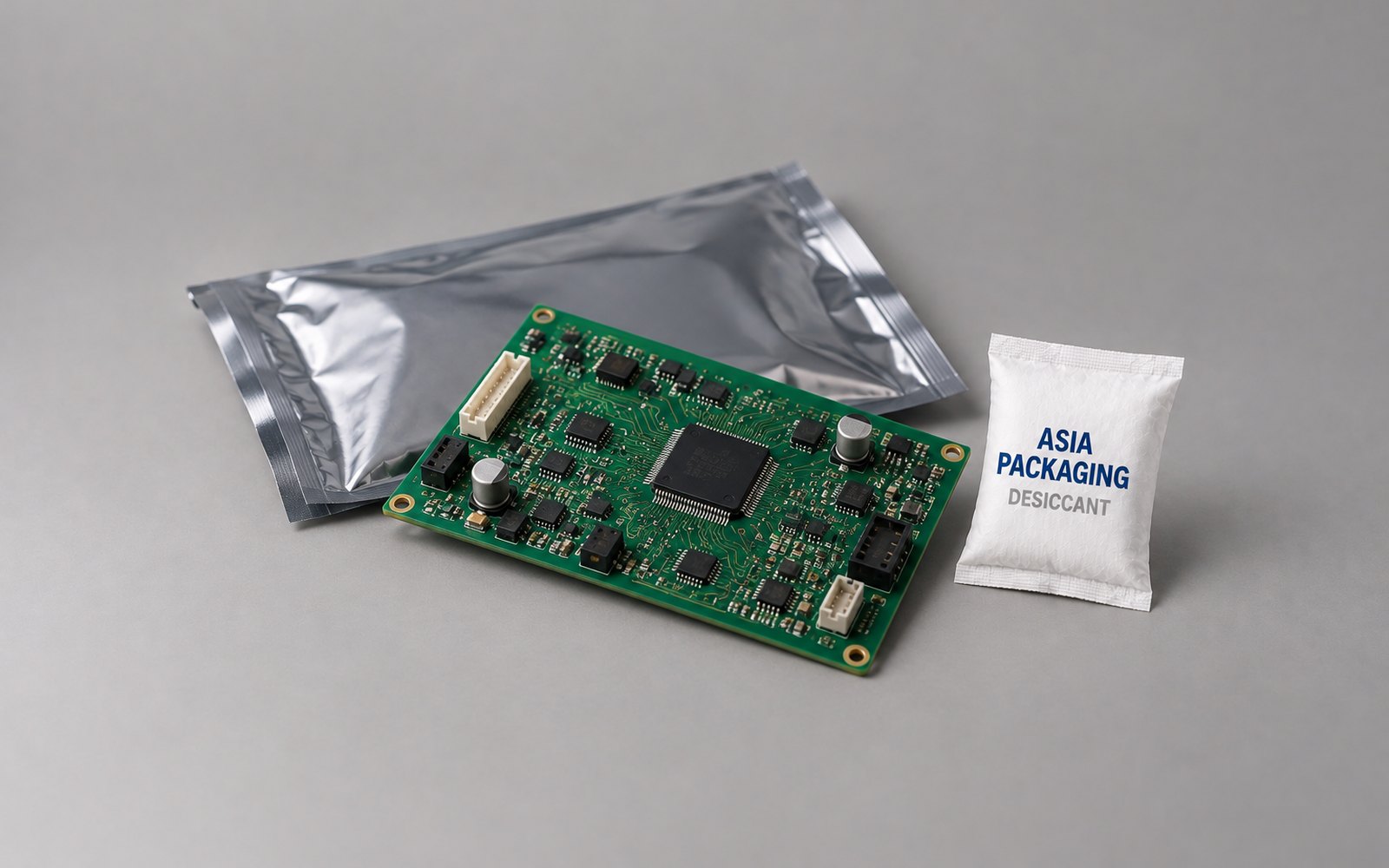
Electronics is the one industry where moisture sensitivity is formally graded — and where the indicator card matters as much as the desiccant.
Electronics is the only industry with a formal grading system for moisture sensitivity, and the reason is a failure mode that leaves no external evidence.
Popcorning
Plastic-encapsulated semiconductor packages absorb water vapour from ambient air while they sit in stores. During reflow soldering, the assembly reaches temperatures well above 200 °C in seconds. Absorbed water inside the package flashes to steam, and the resulting internal pressure delaminates the die from the encapsulant or cracks the package outright.
The failure is called popcorning. The part often looks perfect afterwards, passes a visual inspection, and fails in the field months later.
This is why moisture sensitivity levels exist: they define how long a component may sit exposed to ambient conditions before it must be baked to drive the moisture back out.
Dry packing is a three-part system
Dry packing works only when all three components are present.
The moisture barrier bag provides the seal. Without an intact barrier there is no controlled environment and nothing else matters.
The desiccant charge maintains low humidity inside the bag. Note that this charge is calculated from barrier bag surface area and intended storage duration — permeation through the bag wall dominates — not from enclosed volume as in general packaging. It is a genuinely different calculation.
The humidity indicator card proves the pack held. This is the component most often treated as optional, and it is the one that turns a procedure into evidence.
Choosing the indicator range
Indicator cards come in seven RH ranges: 8%, 5–15%, 10–30%, 10–40%, 20–40%, 30–50% and 10–60%. The card should be chosen so its spots bracket the threshold your procedure specifies — a card that only reads well above your limit tells you nothing useful.
Multi-spot cards — three, four or six spot — give a graduated reading rather than a binary pass or fail. When a bag comes back marginal, a six-spot card tells you how marginal, which is what lets you adjust the desiccant charge intelligently rather than simply doubling it.
Beyond semiconductors
The same principles extend across electrical and electronic equipment, with a useful distinction between transit risk and installed risk.
Assembled boards and instruments in transit need a consumable charge sized to the enclosure.
Installed equipment — switchgear, control cabinets, motors — faces continuous risk in unconditioned buildings, and needs a regenerable solution. Note that an IP-rated cabinet still breathes through cable glands unless they are genuinely sealed; the rating describes water ingress, not vapour exchange.
Vented and oil-filled plant needs the incoming air treated rather than the enclosure charged. A breather with an indicating charge does this, and regenerates at around 150 °C for two hours instead of being replaced.
Practical points
A few things that come up repeatedly:
- Seal quality beats desiccant quantity. A well-sealed bag with a modest charge outperforms a poorly-sealed one with double the desiccant, every time.
- Foil tape is used both to close barrier bags and as an EMI/RFI shielding layer — worth specifying deliberately rather than grabbing whatever is on the bench.
- Floor life is cumulative. The clock does not reset when a bag is resealed.
- Keep the card inside the same barrier as the parts. A card outside the bag measures the warehouse.
Getting the charge right
Because the calculation is driven by bag area and duration rather than volume, it is worth doing properly rather than adapting a carton rule. Send us the bag dimensions, the intended storage period and the humidity threshold in your procedure, and we will come back with a charge and a card range.