In pharma the desiccant is part of the stability case. That changes how it is sized, which format is acceptable, and what paperwork you need.
In most industries a desiccant is a packaging consumable. In pharmaceuticals it is part of the product's stability case — which changes how it is specified, what formats are acceptable, and what documentation has to exist before the first commercial batch.
Sizing to a moisture budget
General packaging uses a rule of thumb: roughly 170 grams per cubic metre of enclosed air. Pharmaceutical packaging does not.
Stability data establishes how much water the product can take up across its shelf life before it moves outside specification. That is the moisture budget. The desiccant charge is then sized against three things: the budget itself, the container headspace, and the permeability of the closure system over the full shelf life.
The result is often quite different from what a volume-based rule would suggest — usually because closure permeation over two or three years dominates the calculation, not the air trapped at the moment of sealing.
Why Tyvek
Tyvek appears throughout pharmaceutical desiccant specifications for reasons that have nothing to do with adsorption.
It is flash-spun high-density polyethylene: breathable enough to pass water vapour freely, strong enough that it does not tear, and — critically — it sheds no fibres. A sachet that splits inside a tablet bottle is a contamination event and a potential recall. A material that will not tear removes that failure mode.
It also survives ethylene oxide, gamma and hydrogen peroxide sterilisation, and takes print cleanly on its sealed side.
Our Tyvek pouches use larger 3–4 mm and 4–5 mm beads rather than fine granules, for the same reason: larger particles are more readily detected and less likely to migrate if a pouch were ever compromised.
Matching format to the line
The best desiccant in the world is useless if it will not run on your equipment.
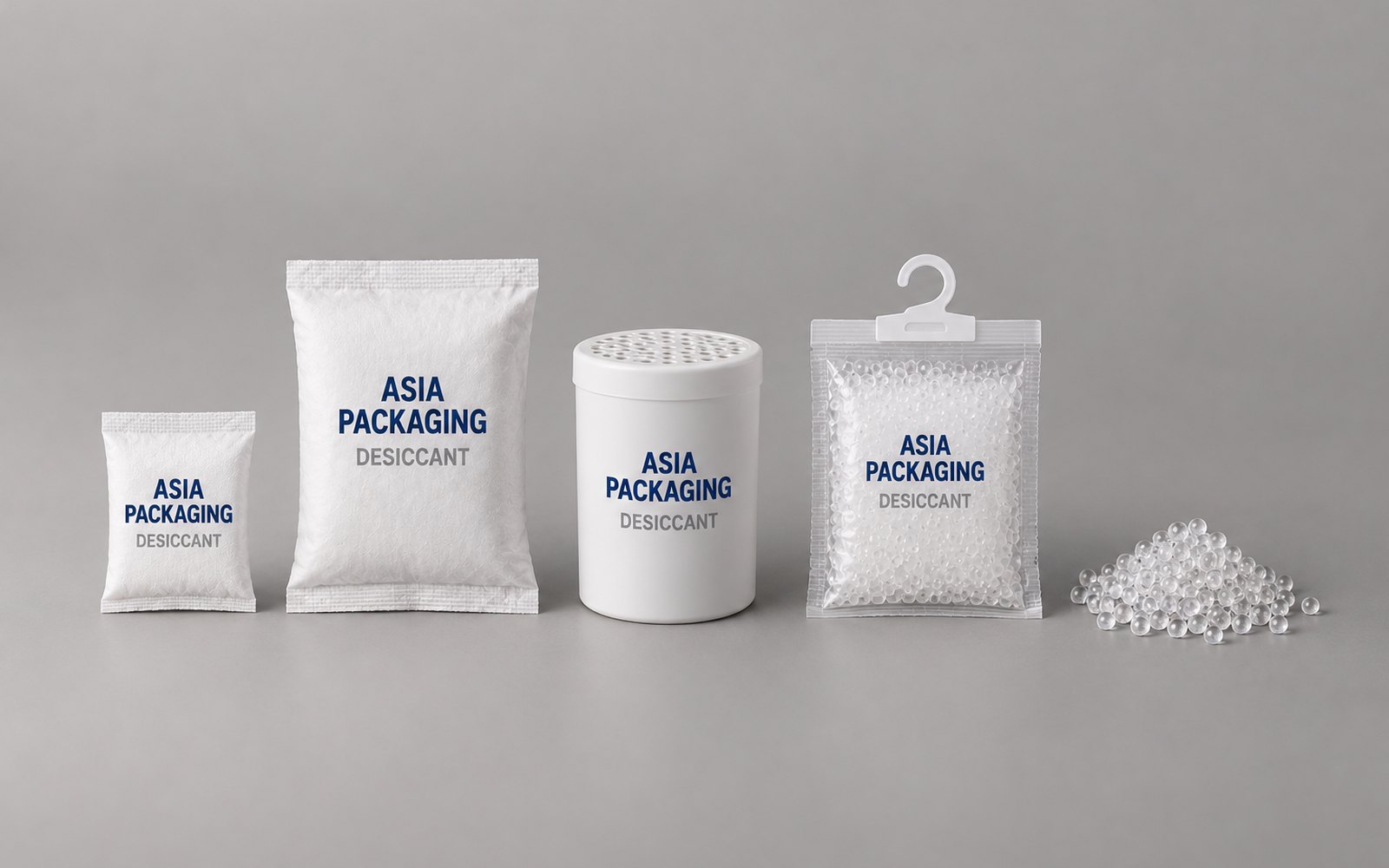
Hand and semi-automatic packing tolerates most formats. Tyvek pouches are the usual choice.
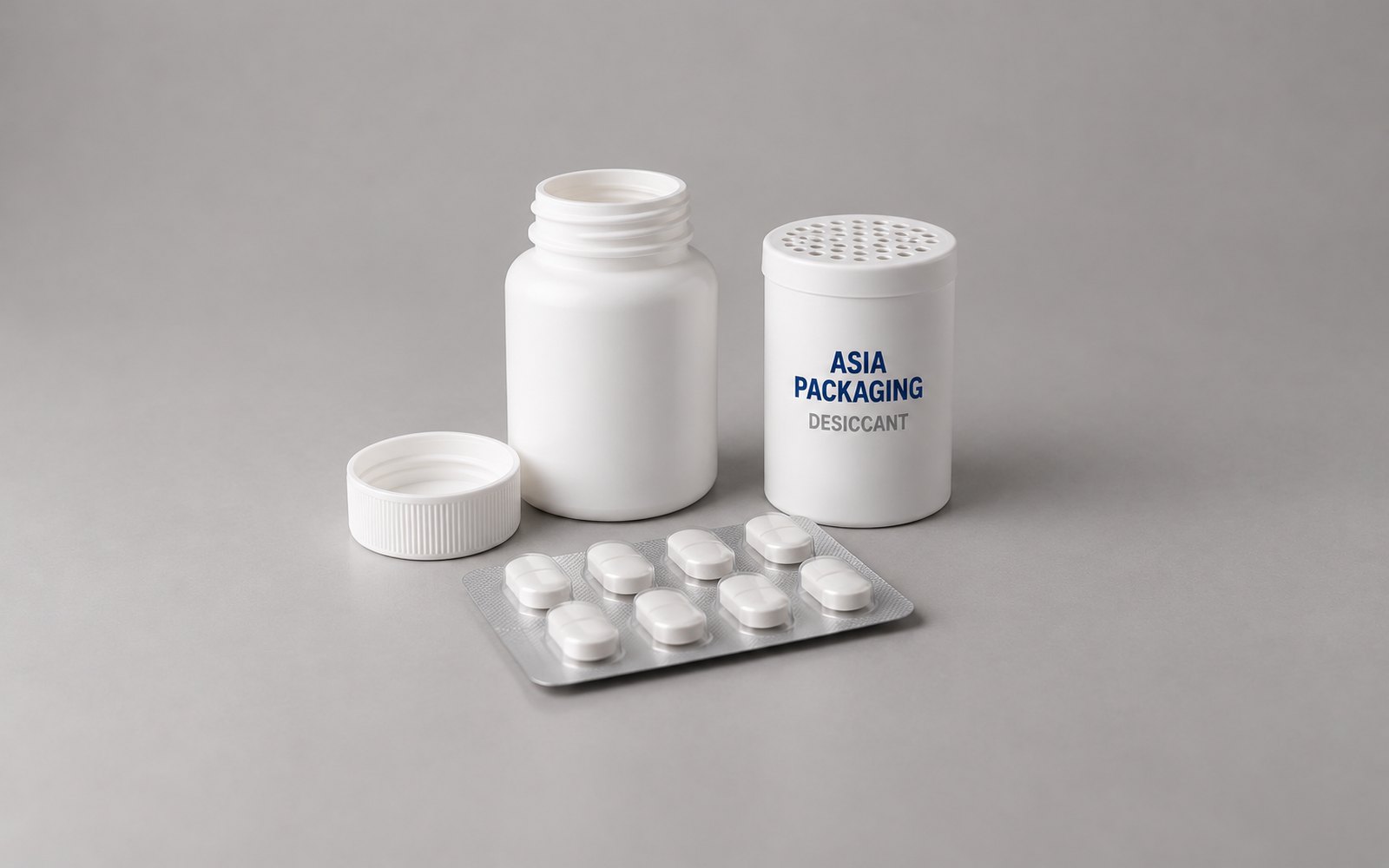
Automated insertion needs something that survives a high-speed insertion head. Rigid HDPE canisters in 1 g, 2 g and 3 g handle this, and remove split-sachet risk entirely. Where odour as well as moisture is a concern, the canister fill can be a silica gel and activated carbon blend.
Continuous high-volume lines use roll form: individual 0.5 g, 1 g or 2 g sachets joined in a strip that mounts directly on the insertion machine, which cuts and drops one per container at line speed. Below a few thousand units a day it is not worth the setup; above that it is the only sensible format.
Where a loose sachet is unacceptable at all — paediatric products, or markets where sachet ingestion is a documented risk — the desiccant moves into the closure. A desiccant cap removes the loose component from the container entirely and simplifies the line to a single part.
Indication and cobalt
Most pharmaceutical applications do not need indicating desiccant: the container is sealed and will not be inspected before use.
Where indication is specified, the practical issue is cobalt. Traditional blue indicating gel is cobalt chloride based, and cobalt is restricted in a number of markets. Orange indicating gel provides the same visual function without cobalt — and switching between them changes nothing else about the packaging.
Get the documentation early
This is where projects lose time. Request MSDS, SGS, RoHS and DMF-free declarations during qualification, not when an auditor asks for them eighteen months later.
Our Tyvek desiccant packs are supplied DMF-free and cobalt-free with MSDS, SGS and RoHS documentation available. Tell us what your market and your customer require and we will confirm what we can supply before you specify it into a submission — which is considerably easier than discovering a gap afterwards.