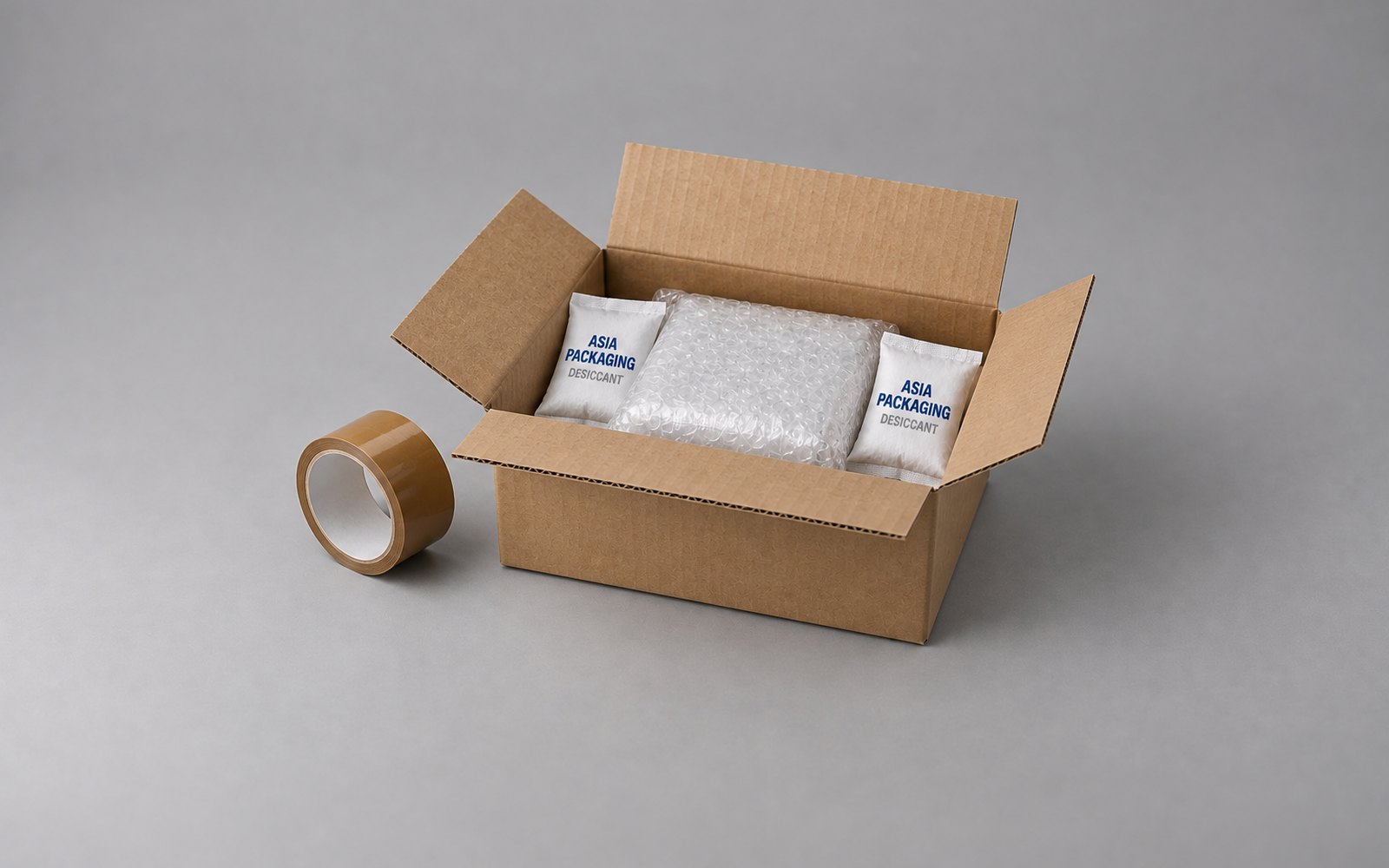
Why moisture protection matters in export packaging
Most water damage claims on dry containers have nothing to do with rain, leaks or rough handling. The water was already inside the box when it was sealed.
6 min read
Read article

No prior knowledge assumed, nothing dumbed down. Thirteen explanations covering what silica gel is, how it works, which grade to choose and how much you need.
Fundamentals
Silica gel is manufactured from synthetic sodium silicate and is, despite its name, a hard granular solid. What makes it useful is its internal structure: a single gram carries a surface area of several hundred square metres, folded into a network of pores a few nanometres across. Water vapour entering that network is held by physical attraction to the pore walls.
Because nothing reacts, the gel does not swell, dissolve, soften or change shape as it loads. A sachet that has taken up 40% of its weight in water feels identical to a dry one. That inertness is why silica gel can sit directly against pharmaceuticals, food and precision metal surfaces.
A hard, porous solid manufactured from sodium silicate — not a gel, and not chemically reactive.
Fundamentals
The distinction between adsorption and absorption matters. A sponge absorbs: water enters the bulk of the material and the sponge becomes visibly wet. Silica gel adsorbs: water molecules adhere to the surface of an internal pore network while the bulk material stays dry.
The process is driven by the difference between the humidity of the surrounding air and the very low vapour pressure at the pore surface. Water moves down that gradient until equilibrium is reached. Raise the temperature and the gradient reverses — which is exactly how regeneration works, driving the water back out at 100–120 °C.
One practical consequence: silica gel's capacity depends on the humidity it is working against. At 90% RH our non-indicating grade takes up ≥70% of its weight. At 20% RH the same material manages ≥5%. A desiccant is not a fixed-size bucket.
By physical adsorption onto pore walls — not absorption, and not a chemical reaction.
Selection
Non-indicating silica gel is plain white and gives no visual signal. Indicating gel carries a moisture-sensitive indicator that changes colour as it loads. The adsorption chemistry underneath is identical; you are paying for information, not performance.
That information is worth buying when the desiccant is accessible and reusable — a transformer breather, an instrument case, a warehouse pallet — because it converts a fixed replacement schedule into a visual check. It is worth less in a sealed carton nobody will open until it reaches the customer.
The trade-off is chemical. Traditional blue indicating gel uses cobalt chloride, which is restricted in some markets. Orange indicating gel achieves the same function without cobalt.
Indicating gel carries a moisture-sensitive dye so it reports its own condition. Everything else is the same.
Selection
White is plain non-indicating gel. It has the widest size range and the highest published capacity at high humidity, and there is nothing to declare on a compliance form. Use it wherever nobody will be looking at the sachet.
Blue is cobalt chloride indicating. As crystals it moves from dark blue to light pink; as beads from blue to white. The contrast is the strongest of the three, which is why it dominates breathers and sight-glass applications. It contains cobalt, which some markets and customers restrict.
Orange achieves indication without cobalt, turning from orange to green. It carries the highest surface area in our range at 700–800 m²/g. It costs more, and it is worth it precisely when the cobalt declaration is the obstacle.
If you are unsure, the deciding question is not performance — it is whether anyone will ever look at the desiccant, and whether cobalt is acceptable in your market.
Three colours, three different answers to the question of whether you need to see the end point.
Calculation
The standard working figure is 5 grams of silica gel per cubic foot of enclosed volume, which is approximately 170 grams per cubic metre. That is the baseline, and it assumes a reasonably sealed enclosure and a normal storage period.
Adjust upward for:
At container scale the arithmetic changes entirely. Silica gel saturates at 40% of its weight, and a container holds far more water than a practical charge could hold. That is why containers use calcium chloride systems rated above 200% instead — typically four to eight Absorpoles per 20 ft container.
Start at 5 g per cubic foot — about 170 g per cubic metre — then adjust for seal quality, duration and cargo.
Fundamentals
A desiccant is any material that removes water vapour from its surroundings. Several types are in routine industrial use and they are not interchangeable:
Silica gel adsorbs physically, holds up to 40% of its weight, and regenerates. The general-purpose choice.
Clay (montmorillonite) is a natural mineral, costs less, and performs better than silica gel at low temperatures. Widely specified in defence packaging.
Calcium chloride deliquesces — it dissolves into the water it absorbs, forming a brine. It holds over 200% of its weight, which is why it dominates container applications, and it must be contained so the brine cannot reach the cargo.
Molecular sieve is a crystalline zeolite with a uniform pore size. It holds less overall but retains its grip at very low humidity, where silica gel gives up.
Choosing between them comes down to how much water there is, how dry it has to get, and what temperature it happens at.
Any material that removes water vapour from the air around it — of which silica gel is one of several.
Export
Container desiccants exist because ordinary desiccants cannot do the job. A 20 ft container of hygroscopic cargo can hold many litres of water across the air, the goods and the packaging. Silica gel caps out at 40% of its own weight, so protecting that container with silica gel would require an impractical charge.
Calcium chloride absorbs over 200% of its weight and converts it into a brine, which is retained in a sealed chamber or gelling layer so it cannot run back onto the cargo. Formats differ mainly in how they mount:
Dosage for a 20 ft container runs from four to eight units, toward the upper end for long humid routes and moisture-carrying cargo.
High-capacity calcium chloride systems designed for the water load inside a sea container.
Fundamentals
Moisture does not cause one kind of damage, it causes several — and they start at different points.
Corrosion on steel effectively begins above about 60% RH at the metal surface. Below that it slows to almost nothing, which is why 50% is the usual packing target.
Mould and fungus need roughly 65% equilibrium relative humidity in the material itself. Organic goods — leather, textiles, timber, food — are the vulnerable group.
Hydrolysis degrades moisture-sensitive pharmaceutical actives with no visible sign at all. The tablet looks fine and has lost potency.
Popcorning in electronics occurs when absorbed water inside a plastic package flashes to steam during reflow and cracks the part from the inside.
Physical change covers caking of powders, softening of snacks, carton compression failure and label lift.
Condensation is the acute version of all of the above: liquid water on a cold surface, which is what container rain delivers overnight.
The practical point is that the target humidity should come from the mechanism you are actually fighting.
Six distinct damage mechanisms, each with a different humidity threshold.
Export
Corrosion needs moisture at the metal surface. Remove it and the reaction effectively stops, which makes transit corrosion a controllable problem rather than an inevitable one.
Seal first. Desiccant in an unsealed crate is wasted — it will equilibrate with the outside air and saturate. A barrier liner is what turns a crate into a controllable enclosure.
Dose the enclosure. Roughly 170 g per cubic metre of net air volume as a baseline, more for long routes or permeable packaging.
Hang, do not bury. A bag suspended in the air space intercepts moving humid air. The same bag underneath the load does very little.
Handle the container separately. On an ocean route the container needs its own calcium chloride charge. Without it, condensation from the box overwhelms the sachets inside the cartons.
Verify once. Put indicator cards in a few cartons on the first shipment. After that you are dosing on evidence.
Seal the enclosure, hold it below 50% RH, and treat the container separately from the carton.
Selection
How much water is there? A carton is a silica gel or clay problem. A shipping container is a calcium chloride problem. Getting this wrong is the most common and most expensive error — silica gel in a container is money spent on a charge that saturates in the first week.
How dry does it have to get? Above about 30% RH, silica gel is efficient. Below that its capacity collapses and molecular sieve is the right medium. If your specification is written as a dew point rather than a percentage, that is usually the signal.
What temperature? Clay outperforms silica gel at low temperatures and costs less. In cold-chain or winter storage it is often the better answer.
Does anyone need to see the end point? If the desiccant is accessible and reusable, indicating gel pays for itself. If it is sealed in a carton nobody will open, it does not.
If you would rather not work through it alone, our three-question finder will narrow it down, or send us the application and we will specify it.
Four questions settle it: how much water, how dry, what temperature, and does anyone need to see it.
Applications
Pharmaceutical desiccant selection has three constraints that do not apply elsewhere.
The moisture budget. Stability data defines how much water the product can take up across its shelf life. The desiccant charge is sized against that budget, the container headspace and the closure's permeability — not against a rule of thumb.
The physical format. It has to survive the line. Hand packing tolerates most formats; automatic insertion needs canisters or roll form; continuous lines need strip. Tyvek is specified throughout because it does not tear and does not shed fibres into the container.
The documentation. MSDS, SGS, RoHS and DMF-free declarations should be requested during qualification, not when an auditor asks. Where the market restricts cobalt, orange indicating gel replaces blue without changing the packaging.
Where a loose sachet is unacceptable at all — paediatric products, or markets where sachet ingestion is a known risk — the desiccant moves into the closure itself.
Size to the moisture budget, choose the format for the line, and collect the documentation early.
Applications
Electronics is the one industry where moisture sensitivity is formally graded. A moisture sensitivity level rating tells you how long a component can sit in ambient conditions before it must be baked — because absorbed water flashes to steam at reflow temperature and delaminates the package internally. The failure is called popcorning, and the part usually looks perfect afterwards.
Dry packing has three components and needs all three:
The moisture barrier bag provides the seal. Without it there is nothing to control.
The desiccant charge is calculated from barrier bag surface area and intended storage period, not from carton volume — a different calculation from general packing.
The humidity indicator card proves the pack held. Choose a card whose spots bracket the threshold your procedure specifies; multi-spot cards give a graduated reading rather than a pass/fail.
Once the bag is opened the floor-life clock starts, and components that exceed it are baked before use rather than risked.
Dry packing is a three-part system: barrier bag, desiccant charge and indicator card.
Export
Export moisture protection is a two-level problem and treating it as one level is why shipments still arrive damaged despite sachets in every carton.
Container level. The box itself needs calcium chloride desiccant sized to route length, climate zones crossed and cargo moisture content. Four to eight Absorpoles for a 20 ft container is the working range. Without this, container rain drips onto cartons all voyage and overwhelms whatever is inside them.
Pack level. Inside the carton, silica gel at roughly 170 g per cubic metre of enclosed air, in a lined or barrier-sealed carton so the dose means something. Use DMF-free grades for any consumer goods — footwear, leather, textiles — because dimethyl fumarate is restricted in major markets.
Verification. On the first shipment, put indicator cards in a sample of cartons. When they come back you will know whether you are over-dosing or under-dosing, and every shipment after that is set on evidence rather than habit.
Two levels of protection, sized to route and cargo, verified on the first shipment.
Go deeper
Full articles on export packing, corrosion prevention, pharmaceutical packaging and desiccant calculation.
Most water damage claims on dry containers have nothing to do with rain, leaks or rough handling. The water was already inside the box when it was sealed.
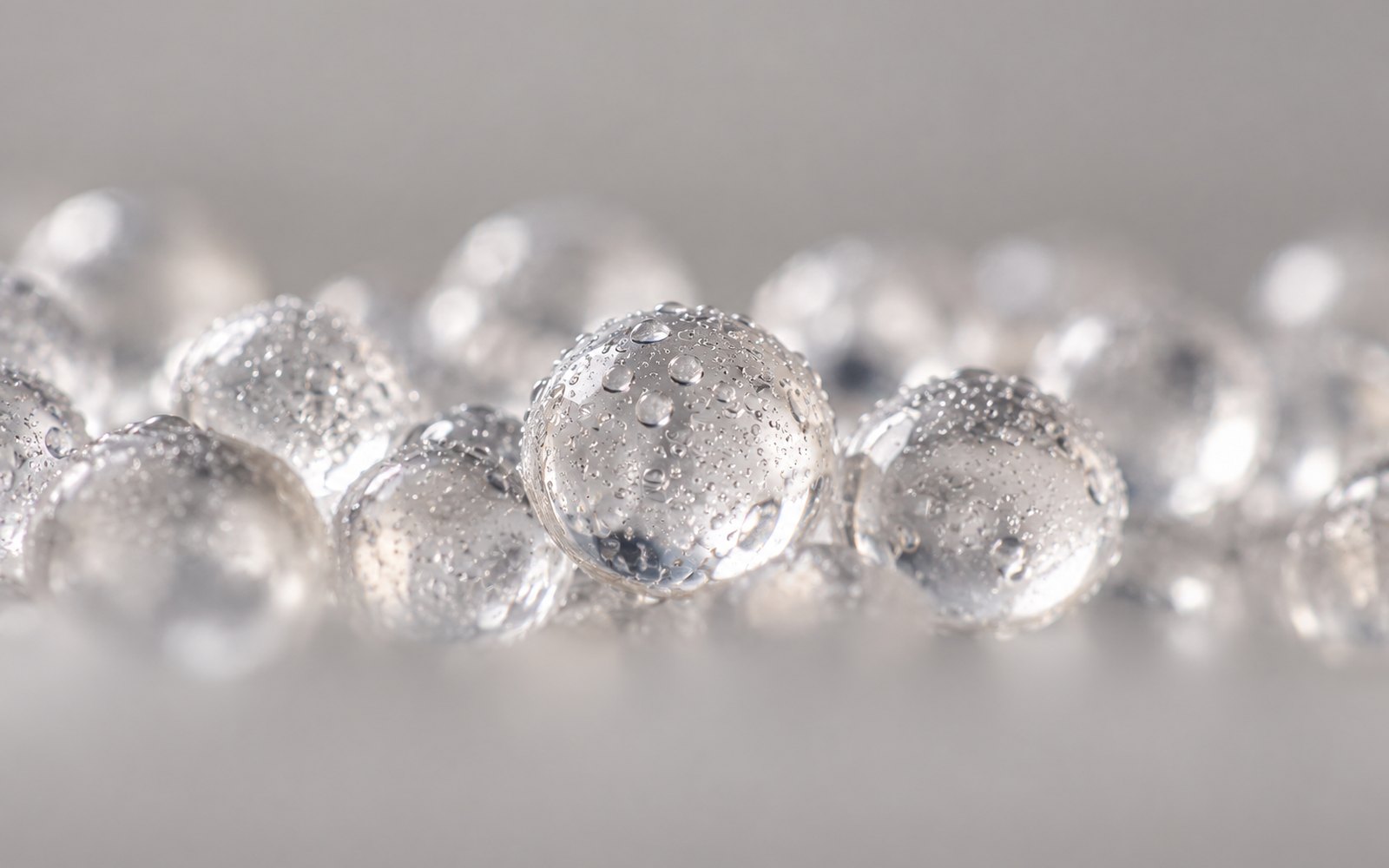
It is not a gel, it does not get wet, and nothing chemically reacts. Understanding what silica gel actually does makes it much easier to use correctly.
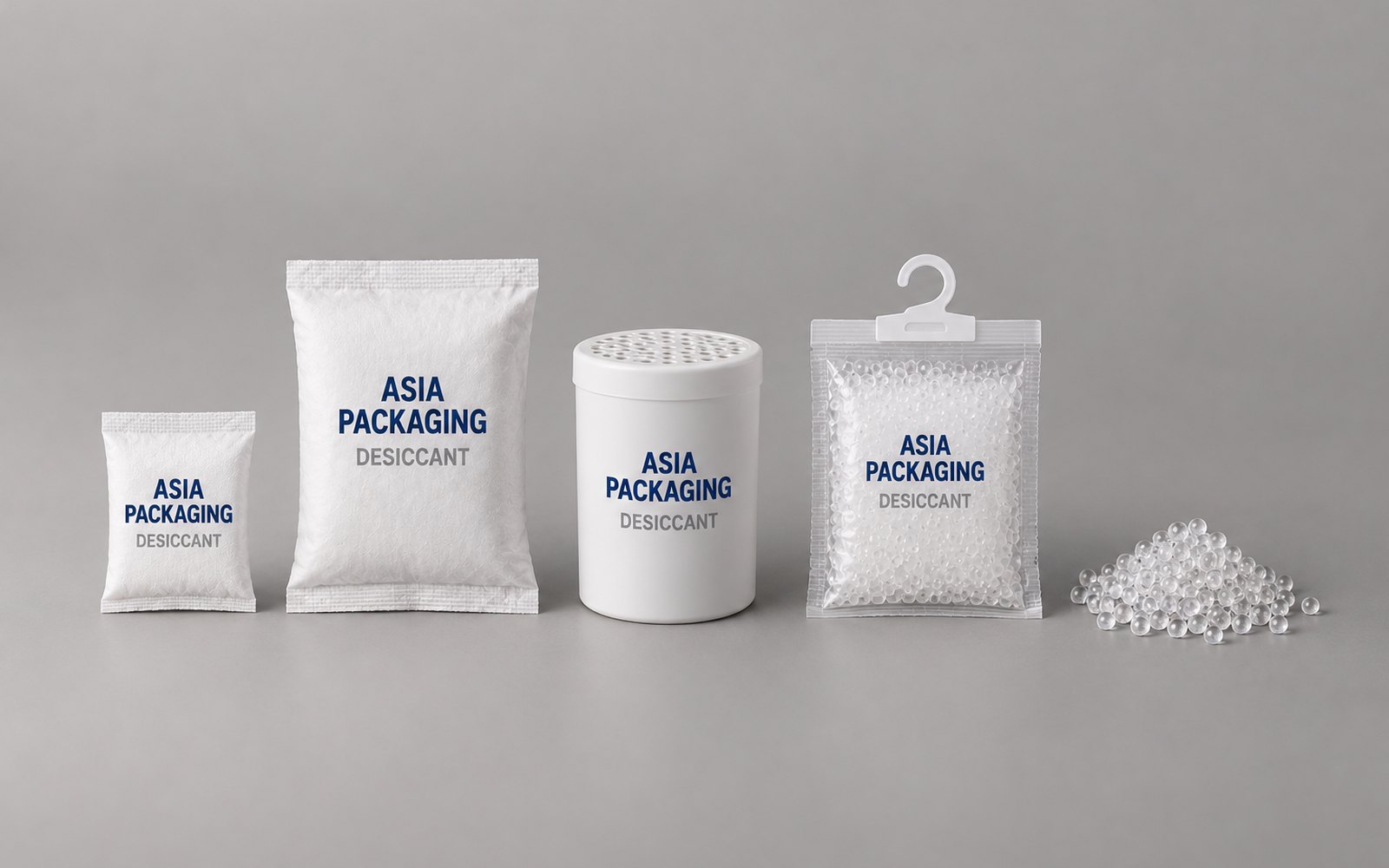
Four questions narrow almost every application down to the right material. Most specification errors come from skipping the first one.
Talk to our experts
Send us the product, the enclosure, the route and the storage period. You will get a desiccant type, a dose and a format back — not just a price list.