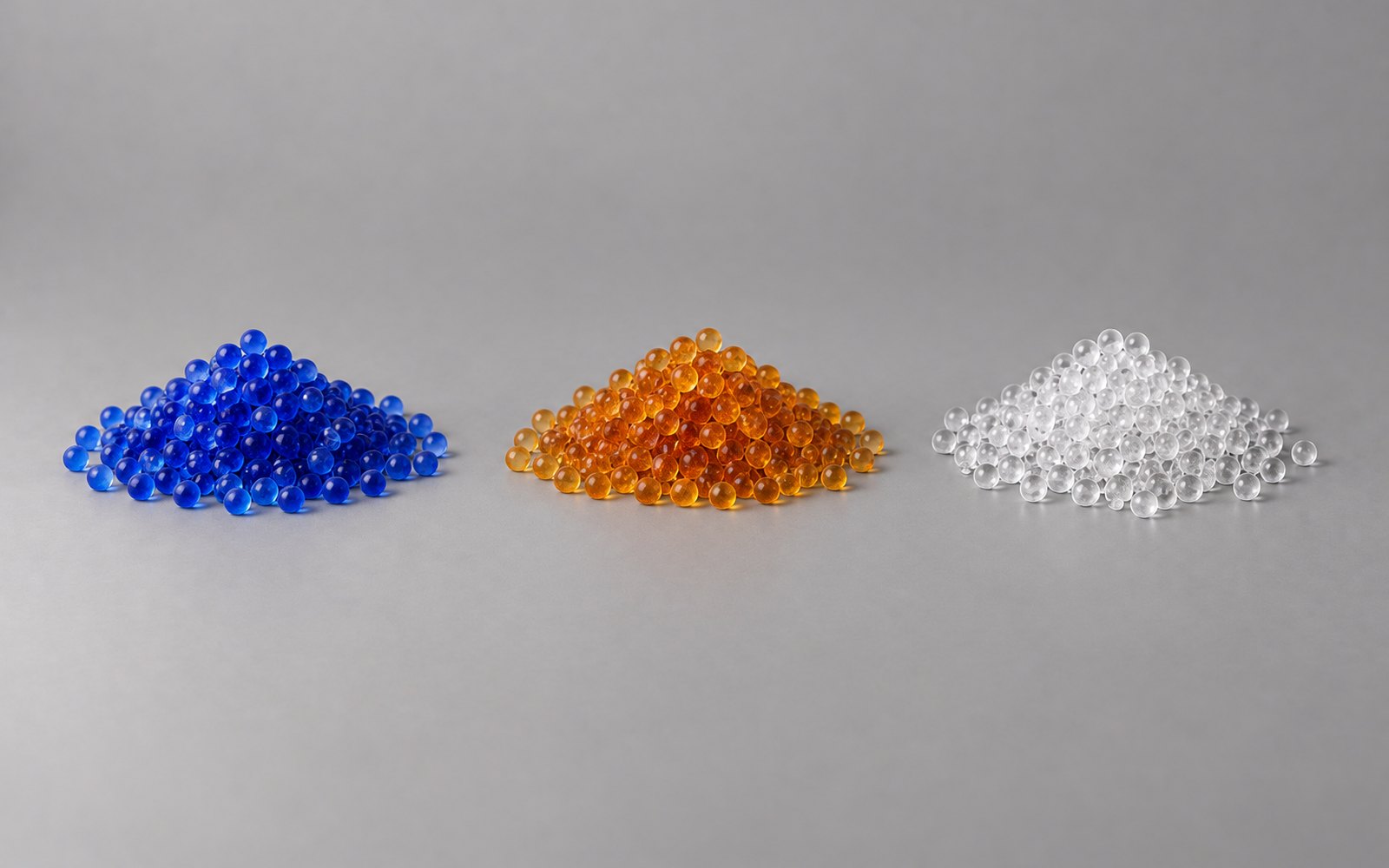
The three colours adsorb almost identically. What separates them is whether anyone will look at the sachet, and whether cobalt is acceptable in your market.
Customers often ask which colour of silica gel performs best, expecting a ranking. The honest answer is that the adsorption chemistry is broadly the same across all three. What you are choosing between is information and compliance, not performance.
White — non-indicating
Plain silica gel with no indicator. It gives no visual signal at all.
What it does offer is the widest size range in our catalogue — eight mesh grades and thirteen particle-size options — and the strongest published high-humidity capacity at ≥70% of its own weight at 90% RH. There is also nothing to declare on a compliance form, which quietly matters in regulated supply chains.
Use it wherever nobody will ever look at the desiccant: sealed cartons, barrier bags, bulk drying, high-volume sachet filling.
Blue — cobalt chloride indicating
The traditional indicating grade, and still the most visually decisive.
Crystals move from dark blue to light pink. Beads move from blue to white. That colour shift has the strongest contrast of the three options, which is why blue dominates transformer breathers, sight glasses and anywhere the gel is viewed through a window or at a distance.
Specified at minimum 33% adsorption at 100% RH, with SiO₂ at 96–98% and bulk density 0.600–0.700 g/cc.
The constraint is chemical: it contains cobalt chloride, and cobalt is restricted in a number of markets and by many end customers. If that applies to you, blue is not available regardless of how well it works.
Orange — cobalt-free indicating
Orange exists to solve exactly that problem: indication without cobalt. It moves from orange to green as it loads.
It also carries the highest surface area in our range — 700–800 m²/g, against 450–650 for the non-indicating grade — with a tightly specified pore structure: average pore size 2.0–2.5 nm, pore volume 0.35–0.40 ml/g, and adsorption ≥30% at 90% RH.
It costs more. It is worth it precisely when the cobalt declaration is the obstacle — which is increasingly often in pharmaceutical, food-adjacent and European-market applications.
Deciding
Two questions, in order.
Will anyone actually look at this desiccant? If it is sealed in a carton and will not be inspected until it reaches the customer, indication adds cost and no value. Choose white.
If yes — is cobalt acceptable in your market? If it is, blue gives the strongest visual signal. If it is not, orange does the same job without the declaration.
That is the whole decision. There is no hidden performance dimension.
A note on regeneration
All three grades regenerate by heating at 100–120 °C, and can be cycled repeatedly.
Worth knowing: indicating grades gradually lose colour strength through repeated regeneration while the gel underneath still adsorbs perfectly well. The dye tires before the desiccant does. Gel that has gone pale is not necessarily spent — but since you specified indicating gel in order to trust the colour, faded material has lost the thing you were paying for and should be replaced.