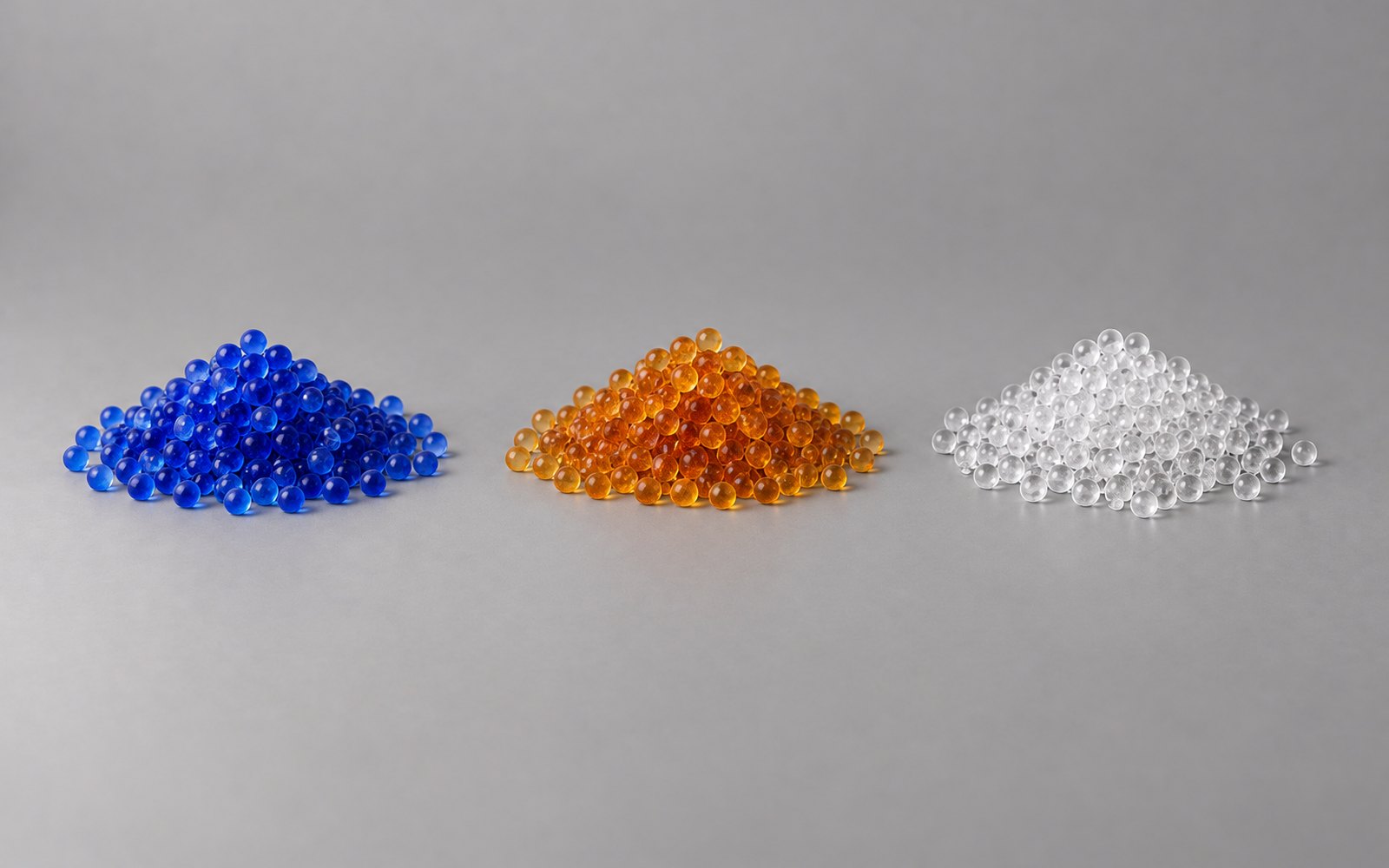
It is not a gel, it does not get wet, and nothing chemically reacts. Understanding what silica gel actually does makes it much easier to use correctly.
Silica gel is one of the most widely used industrial materials that almost nobody understands. It is not a gel. It does not get wet. Nothing reacts. And those three facts, properly understood, explain most of what you need to know about using it well.
What it actually is
Silica gel is manufactured from synthetic sodium silicate and emerges as a hard, glassy solid — supplied as irregular crystals or spherical beads. The name is a historical accident from its production process, not a description of the product.
What matters is the internal structure. A single gram contains a network of pores a few nanometres wide, and the total internal surface area runs to several hundred square metres. Our non-indicating grade is specified at 450–650 m²/g; the orange indicating grade reaches 700–800 m²/g. One gram of material, most of a football pitch of surface.
Adsorption, not absorption
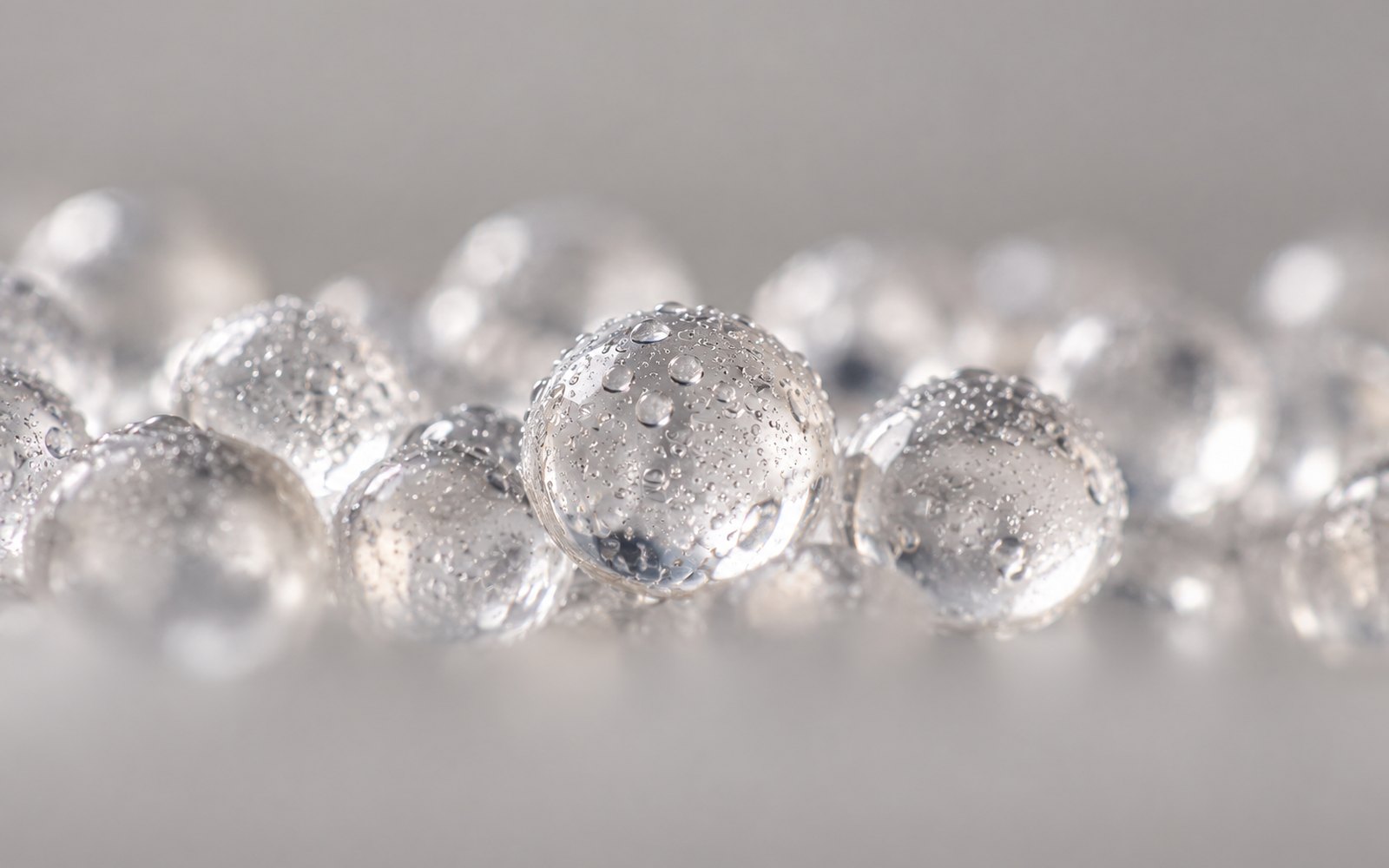
The distinction is not pedantry. A sponge absorbs: water enters the bulk of the material and the sponge becomes visibly, obviously wet. Silica gel adsorbs: water molecules adhere to the surface of that internal pore network while the bulk material remains dry.
This is why a silica gel sachet holding 40% of its weight in water feels exactly like a dry one. It does not swell, soften, dissolve or change shape. It is why a sachet can sit directly against a pharmaceutical tablet, a machined surface or a leather shoe without any risk of transferring moisture to it.
Why capacity is not a fixed number
Here is the part that catches people out. Silica gel does not have a single capacity figure. It has a curve.
Adsorption is driven by the difference between the humidity of the surrounding air and the very low vapour pressure at the pore surface. Water moves down that gradient until equilibrium. The steeper the gradient — the more humid the air — the more water the gel will hold.
Our published figures for non-indicating grade show this clearly:
- At 20% RH: ≥5% of its own weight
- At 50% RH: ≥13%
- At 90% RH: ≥70%
That is a fourteen-fold difference across the working range. A desiccant is not a bucket of fixed size, and any calculation that treats it as one will be wrong at one end or the other.
It also explains why silica gel is the wrong material below about 30% RH. Its capacity there is negligible, which is why aerospace and refrigerant applications use molecular sieve instead.
Why it works inside a sachet
A frequent question: if the gel is sealed in a pouch, how does moisture reach it?
The pouch materials are chosen specifically to be breathable. Tyvek, non-woven, paper and cloth all pass water vapour freely while retaining the granules. The gel is contained; the vapour is not.
This is also why the choice of pouch material is a handling decision rather than a performance one. Tyvek where the pack must not tear. Cloth where it will be handled roughly. Paper where cost dominates.
Why it only works in a sealed space
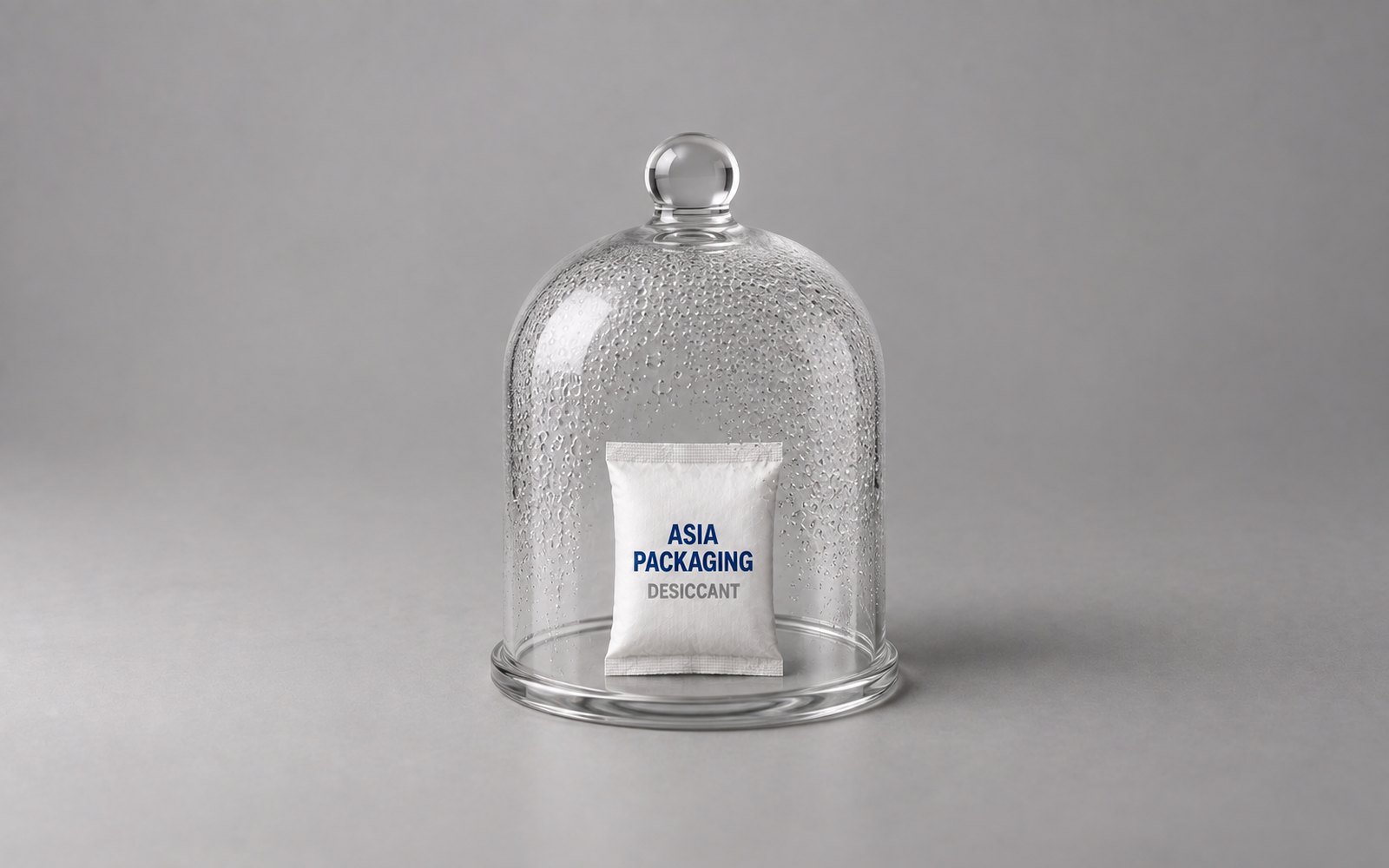
Silica gel is only effective in an enclosed environment. In a space with a constant supply of fresh air, the gel will draw moisture from that inexhaustible supply, saturate, and stop.
This single point accounts for most disappointing results we hear about. Desiccant in an unsealed crate is not underperforming; it is doing exactly what physics requires. The seal is not an optional refinement around the desiccant — it is the thing that makes the desiccant meaningful.
And it is reversible
Because nothing reacted, nothing is consumed. Heat silica gel to 100–120 °C and the gradient reverses, driving the water back out. Breather charges regenerate at around 150 °C for two hours and go straight back into service.
Indicating grades will eventually lose colour strength through repeated cycling even while the gel underneath still works perfectly — the dye tires before the desiccant does.