Four questions narrow almost every application down to the right material. Most specification errors come from skipping the first one.
We are asked to quote for silica gel far more often than we are asked what the customer should actually use. Those are different questions, and the second one is usually more valuable — particularly because silica gel is the wrong answer more often than people expect.
Four questions settle most applications.
1. How much water is there?
This is the question that matters most and gets skipped most.
A carton, a barrier bag, an instrument case — these are silica gel or clay problems. The total water involved is modest, and a material holding 40% of its weight is entirely adequate.
A shipping container is a different problem by an order of magnitude. Between the air, the cargo, the pallets and the packaging, the water in a loaded container runs to many litres. Protecting it with silica gel would need a charge nobody would pay for or install, and what actually happens is that a normal charge saturates in the first week.
Calcium chloride absorbs over 200% of its own weight — five times the ratio — and holds it as a brine that cannot return to the cargo. That capacity difference is the entire reason container desiccants exist as a separate product category.
Getting this wrong is the most expensive mistake in the field, and it is usually made by someone applying a carton-scale habit to a container-scale problem.
2. How dry does it need to get?
Silica gel works efficiently between roughly 30% and 90% relative humidity. That covers the great majority of packaging applications, where the target is simply to stay below 50% — comfortably inside its effective range.
Below about 30% RH its capacity collapses. At 20% RH our non-indicating grade holds only around 5% of its weight. If your specification calls for conditions that dry, silica gel is not the right medium.
Molecular sieve is. It is a crystalline zeolite with a uniform pore size that holds tightly at very low humidity, which is why it appears in insulating glass, refrigerant circuits, gas purification and aerospace preservation.
A useful signal: if your specification is written as a dew point rather than a percentage, you are probably in molecular sieve territory.
3. What temperature does this happen at?
Clay desiccant — natural montmorillonite — outperforms silica gel at lower temperatures and costs less per unit. In cold-chain applications, winter storage and unheated warehousing it is frequently the better technical answer as well as the cheaper one.
It is also long established in defence packaging, partly for that low-temperature behaviour and partly because its composition is published rather than proprietary, which suits documentation requirements.
4. Does anyone need to see the end point?
Indicating and non-indicating silica gel adsorb identically. The indicator adds information, not performance — so the question is whether that information has value in your application.
It has real value when the desiccant is accessible and reusable. A transformer breather with a sight glass, an instrument case opened at intervals, pallets in a warehouse: in all of these, indication replaces a fixed replacement schedule with a visual check. That saves both premature disposal and silent failure.
It has little value inside a sealed carton nobody will open until it reaches the customer.
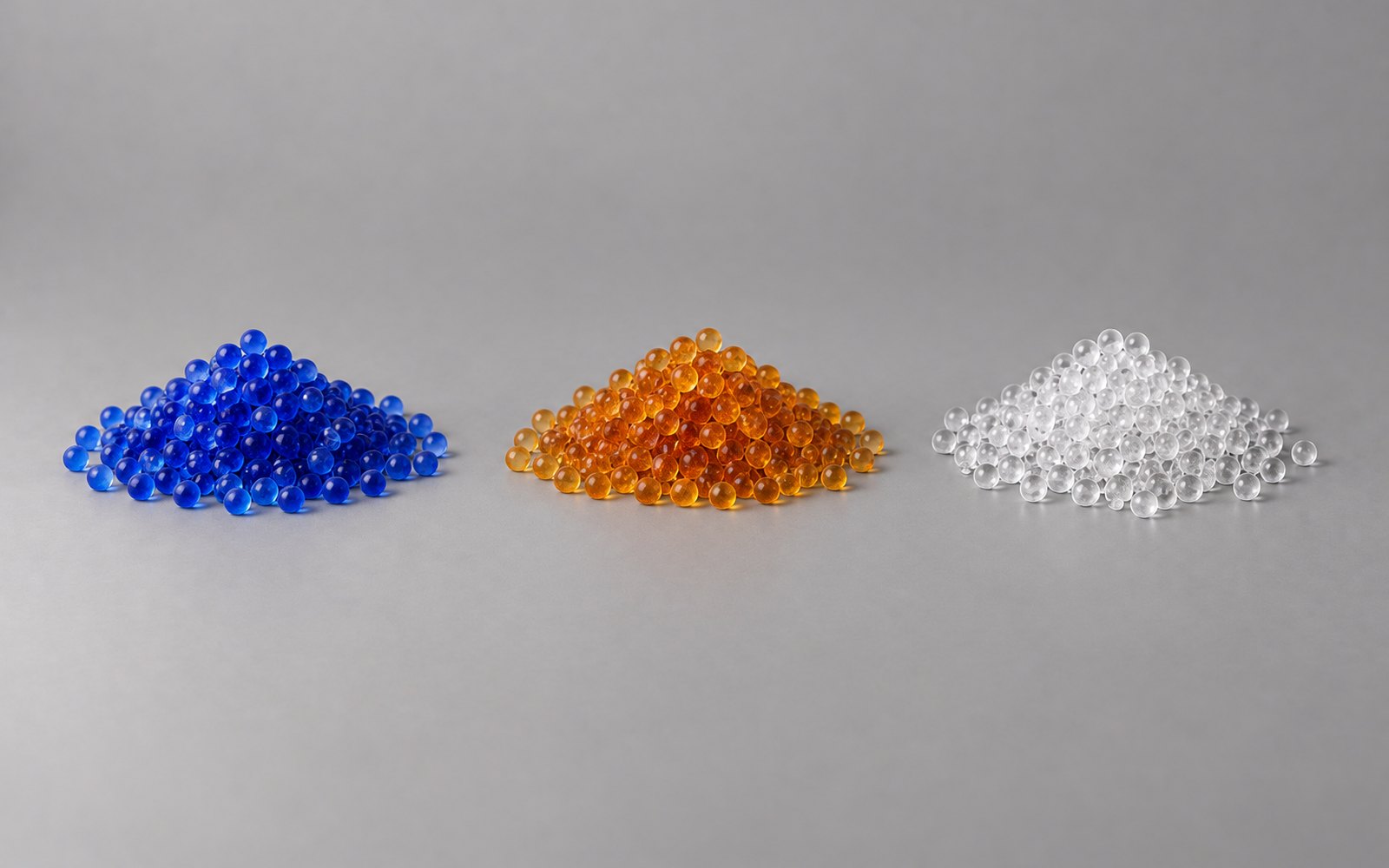
If you do need indication, the remaining question is chemical. Traditional blue gel uses cobalt chloride, which some markets and customers restrict. Orange indicating gel gives the same function without cobalt, at a higher price.
Two constraints that override everything
Food contact. Only SGS-certified food-grade material goes near food. This is not a performance question.
DMF-free. For footwear, leather, textiles and consumer goods, dimethyl fumarate is restricted in major export markets. A non-compliant sachet is a market-access problem regardless of how well it controls moisture.
When in doubt, describe the problem
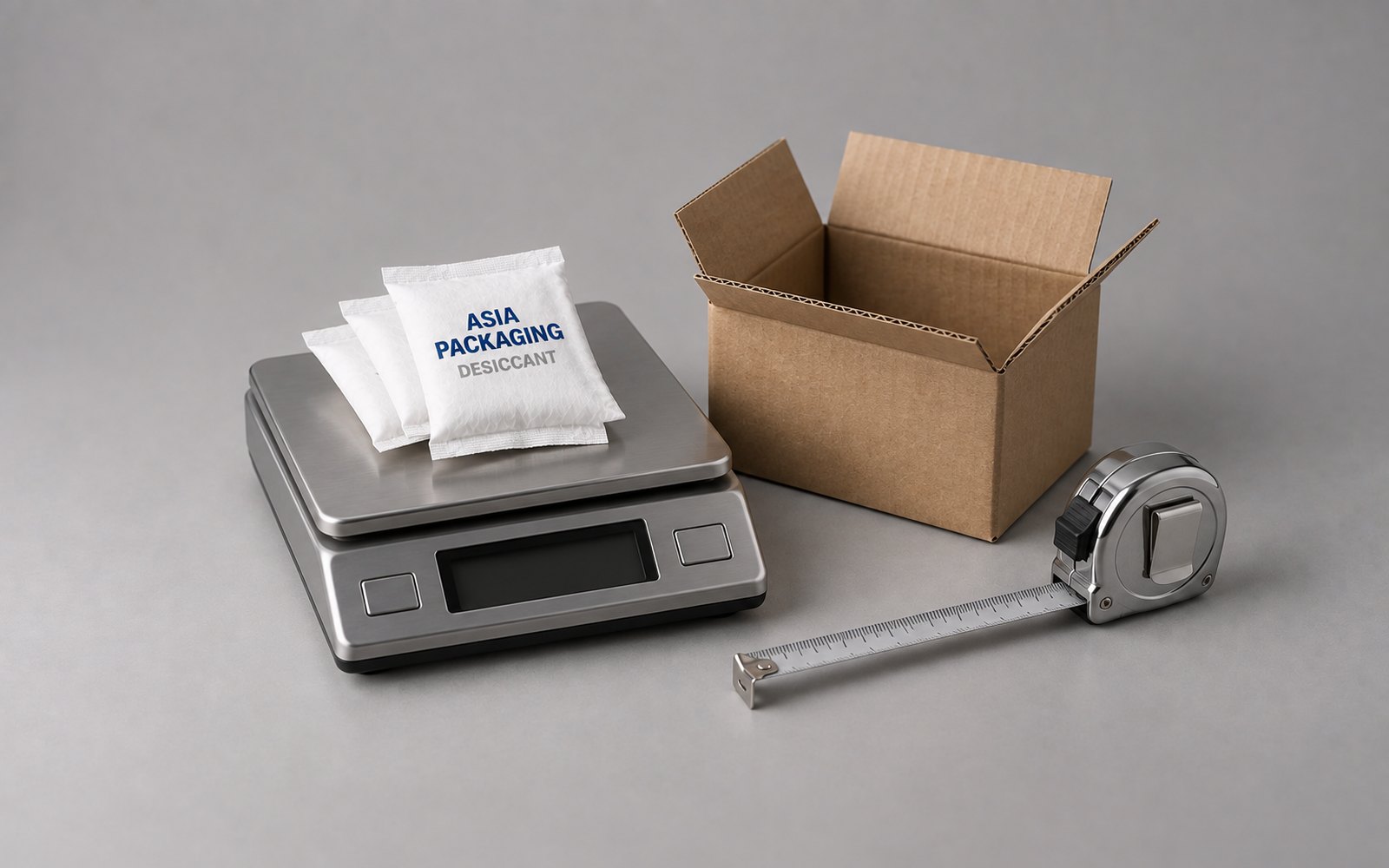
The most productive enquiries we receive do not name a product. They describe the item, the enclosure dimensions, the route and the storage period — and let us come back with a material, a dose and a format.
That conversation takes about ten minutes and routinely saves considerably more than it costs.