Four to eight poles per twenty-foot container. Where that number comes from, and what changes it.
Container desiccation is one of the few areas of packaging where there is a straightforward working number: four to eight units per 20 ft container. It is worth understanding where that range comes from, because knowing which end of it you are at is what makes the difference.
The mechanism
A sealed container is a closed thermodynamic system with a large steel thermal mass. On a voyage crossing climate zones it cycles daily: heating during the day, cooling at night, with the roof cooling fastest of all.
When the roof surface drops below the dew point of the internal air, water condenses on it. It collects, coalesces, and drips back onto the cargo below. Every night, for the length of the voyage.
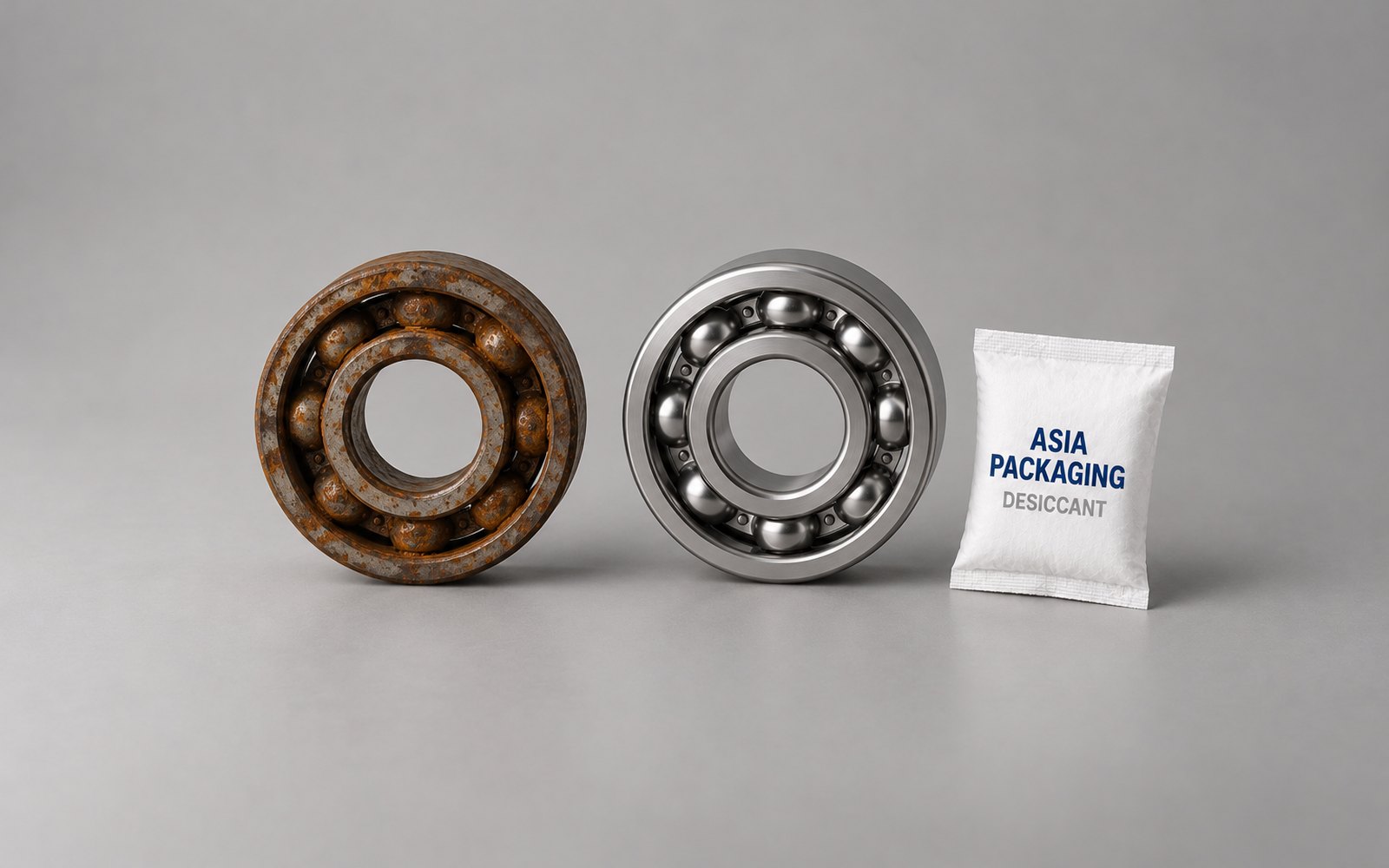
The corrosion, mould and staining that show up at destination are the result of that cycle repeated thirty or forty times — not of a single dramatic event.
Why capacity is the whole story
Silica gel adsorbs up to 40% of its own weight. Calcium chloride absorbs over 200%. In most applications that ratio is an interesting technical detail; in a container it decides whether the protection works at all.
The water inventory in a loaded container — air, cargo, pallets, corrugated — runs to litres. Silica gel at 40% capacity would require a charge that is neither practical to install nor economic to buy. Calcium chloride at 200%+ brings it into range.
Crucially, calcium chloride deliquesces: it dissolves into the water it absorbs. That brine must be retained where it cannot reach the cargo, which is why every serious container desiccant has a sealed collection chamber or a gelling layer. A container desiccant that leaks is worse than none at all.
Choosing a format
The three formats differ mainly in how they mount, and the right one is usually decided by the container and the crew rather than by performance.
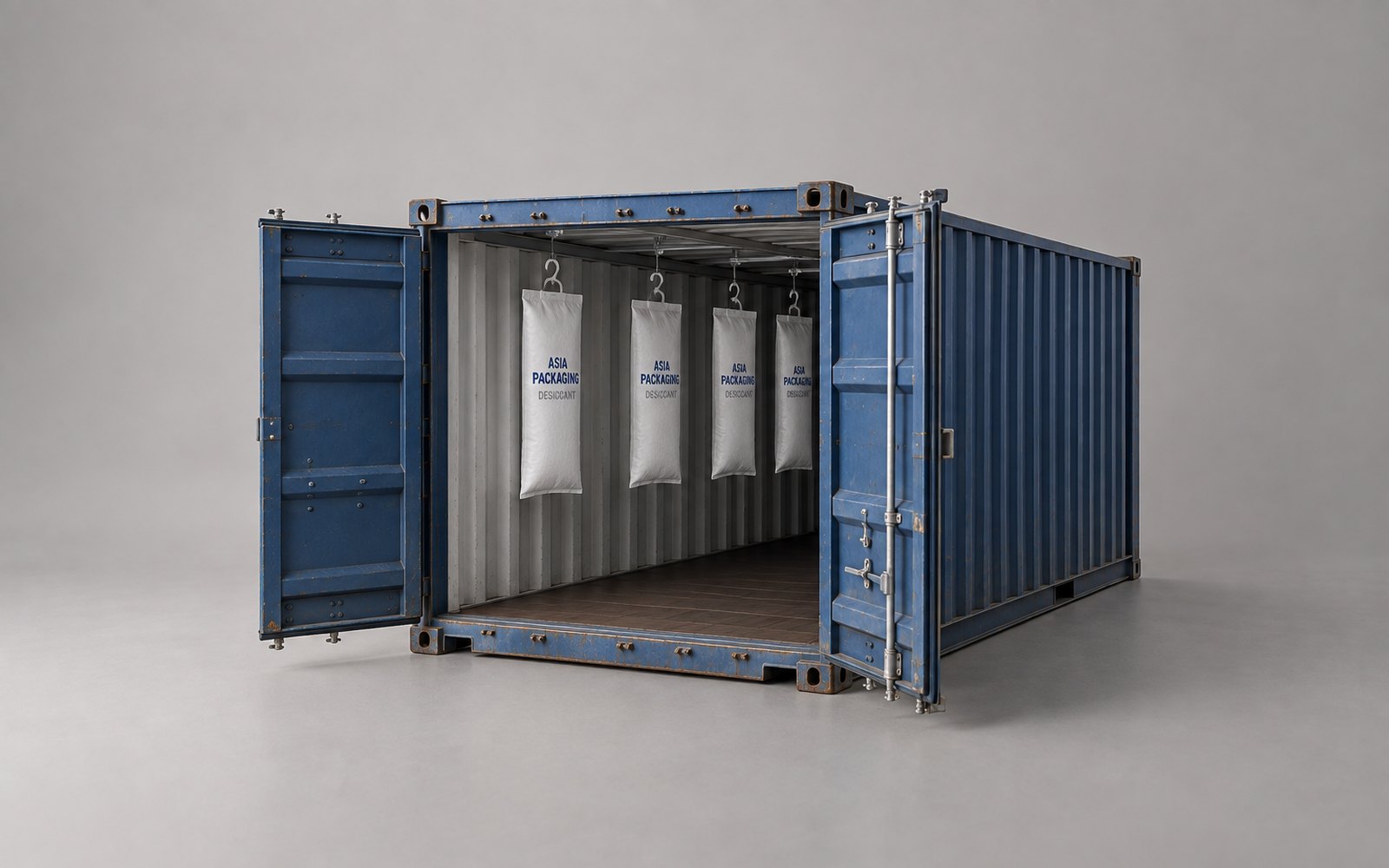
Absorpoles hang vertically in the corrugated recess of the container side panel. That recess is space cargo cannot use anyway, so the desiccant costs no payload volume. The brine chamber sits below the active salt, so as the calcium chloride dissolves the liquid drains away from the material still working — it does not blind itself.
Container bags hang from the lashing rails and suit loads where the side panels are obstructed.
Adhesive cargo bags stick flat to a wall or crate panel. They exist for containers with no usable hanging points and for packers who would rather not work at height. Our 1 kg unit is divided into five 200 g sections so it can be distributed along a load rather than concentrated at one end.
Where in the range you sit
Move toward four units for short routes, dry cargo, temperate conditions and containers loaded in low humidity.
Move toward eight units for:
- Long routes crossing multiple climate zones
- Hygroscopic cargo — textiles, leather, timber, coir, agricultural goods
- Loading in monsoon or high-humidity conditions
- Timber pallets and heavy corrugated, which carry significant moisture
- High-value cargo where the cost of the additional units is trivial against the claim
Placement
Desiccant belongs high, in the air space near the ceiling where condensation actually forms. Units buried in or behind the load see far less of the moving air and do proportionally less work.
It is worth recording placement and dosage on the packing note. If a claim does arise, documented protection is a considerably stronger position than a verbal assurance that desiccant was used.
A note on food and agricultural cargo
Food and agri shipments should use food-grade container desiccant. Our container dry desiccants blend bentonite clay with calcium chloride in a food-grade formulation inside DuPont Tyvek, and also address the transit odour that these cargoes commonly develop.