Start at 170 grams per cubic metre, then adjust for the four things that actually change the answer.
Desiccant dosage tends to be either copied from a previous specification or guessed. Both approaches produce specifications that are wrong in one direction or the other — and under-dosing is considerably more expensive than over-dosing.
Here is how to work it out properly.
The baseline
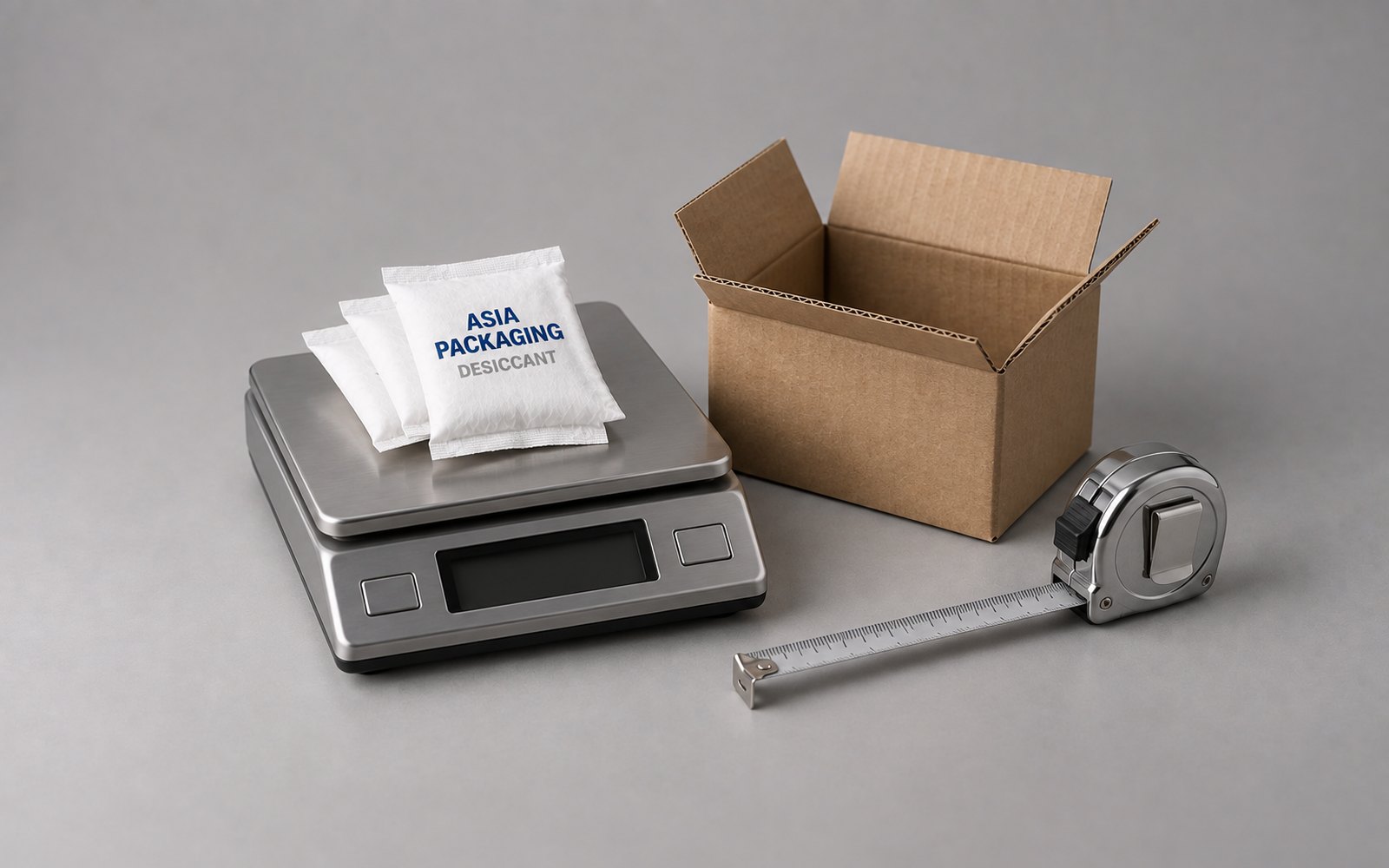
The standard working figure is 5 grams of silica gel per cubic foot of enclosed volume, which is approximately 170 grams per cubic metre.
Two qualifications matter immediately.
First, this is net enclosed air volume — the space left after the product is in place, not the external dimensions of the box. A dense casting in a crate displaces most of the volume, and dosing on crate dimensions can over-specify several times over.
Second, it assumes a reasonably sealed enclosure. In an unsealed one the figure is meaningless, because the desiccant is equilibrating with the outside atmosphere rather than with your enclosure.
Four adjustments
1. Seal quality. The dominant variable. A properly sealed barrier bag holds the baseline dose. Plain corrugated without a liner leaks continuously and needs substantially more — or better, a liner, which is cheaper than the extra desiccant.
2. Duration. A two-week domestic move and a six-month sea-plus-storage journey are different problems. The longer the period, the more moisture permeates in, and permeation — not the air trapped at sealing — usually dominates long-duration calculations.
3. Cargo moisture. Textiles, leather, timber, coir, paper and agricultural goods carry water and release it into the enclosure. For these, the goods are the moisture source and the air volume calculation understates the requirement considerably.
4. Sealing conditions. Sealing a carton at 85% RH in monsoon conditions traps that air inside it. The same carton sealed in a conditioned room starts from a much better position. This one is often free to fix.
Electronics is a different calculation
Dry packing for moisture-sensitive devices is not dosed on volume at all. The charge is calculated from barrier bag surface area and intended storage duration, because permeation through the bag wall dominates over the small trapped air volume.
Applying a volume-based rule to a barrier bag will under-dose it. This is a genuinely separate method, not a variation.
Containers are a different problem entirely
Do not scale the silica gel figure up to container size. The arithmetic does not survive the journey.
Silica gel saturates at 40% of its own weight. The water inventory in a loaded container — air, cargo, pallets, corrugated — runs to litres, and the silica gel charge required would be neither practical nor economic. What happens in practice is that a normal charge saturates early and the container is unprotected for most of the voyage.
Containers use calcium chloride at over 200% capacity: four to eight units per 20 ft container, toward eight for long humid routes and hygroscopic cargo.
Round up to a stocked size
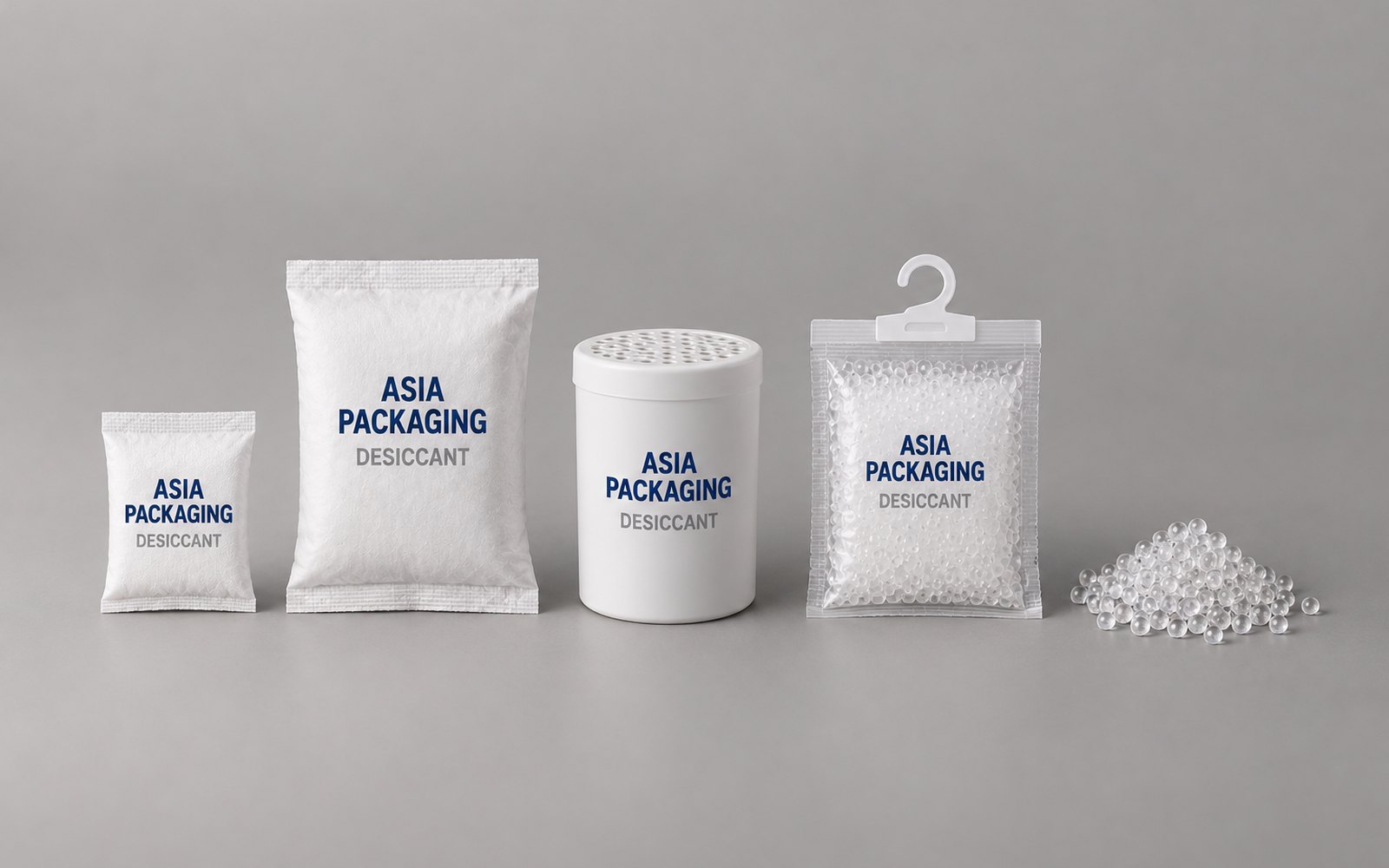
Once you have a figure, round up to a standard size rather than down. We stock fourteen pouch weights from 0.5 g to 5 kg, and bags from 200 g to 5 kg, specifically so that most calculations land close to something available.
One correctly-sized sachet is better than three small ones: fewer units to handle, fewer to omit by mistake, and a lower packing cost per unit.
Then verify it once
Every calculation is an estimate until something measures it.
Put humidity indicator cards into a sample of packs on the first shipment under a new specification. What comes back tells you whether you are comfortably inside your threshold, marginal, or over-dosed. After that one exercise you are dosing on evidence.
It is the cheapest thing in this entire article and almost nobody does it.
Or let us do the arithmetic
Our desiccant calculator handles the baseline and the adjustments, and will suggest a product and pack size. For anything unusual — a permeable enclosure, a multi-year preservation requirement, a dew point specification — send us the details and we will work it through with you.